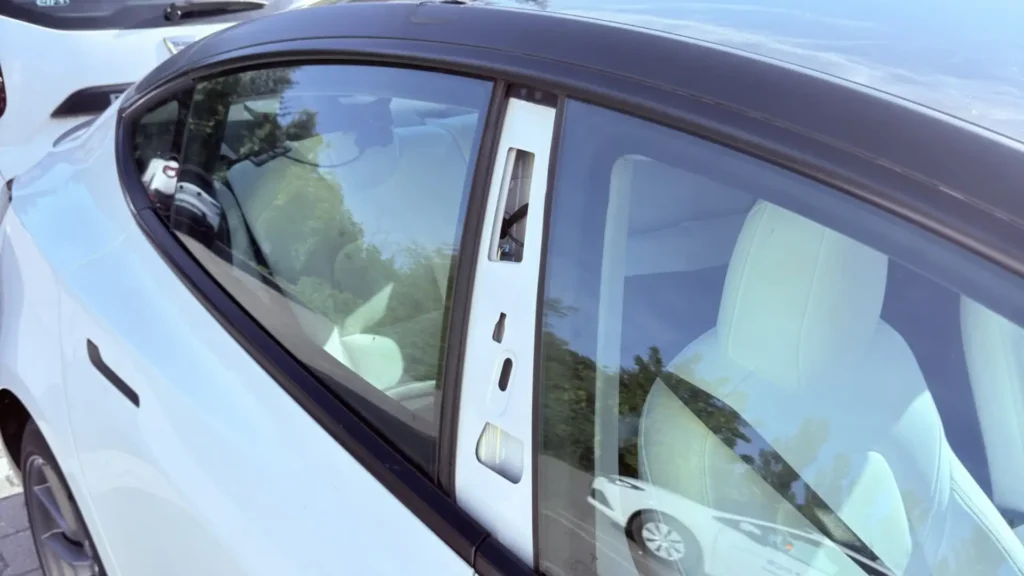
A 2022 Tesla Model 3 that left the factory with Hardware 3 has been fully converted to Hardware 4 and is now driving with FSD (Supervised) v14. The retrofit, described as a “nightmare,” required an HW4 computer swap, ECU modifications, camera adapters that reused the original wiring, a new windshield, different camera mounts and headliner work, yet it proves the upgrade is technically possible on older cars.
What the latest update adds
The car no longer runs as a partial proof-of-concept with one camera online, and now operates with the full FSD (Supervised) v14 stack on the HW4 computer, while earlier stages only brought a single camera feed to life. The builder says the final phase pushed the project beyond simple ECU tweaks and adapter wiring, and added structural changes such as a new windshield to match HW4’s camera housing, revised camera mounts and headliner modifications to route and secure the updated hardware.


Michał Gapiński, a Poland-based software and embedded-systems engineer, led the effort and swapped the original HW3/AI3 Full Self-Driving computer for an HW4/AI4 unit taken from another Tesla, then applied light ECU changes so the new board could talk to the 2022 Model 3’s existing systems. He used custom adapters to bridge the original coaxial camera cables to HW4-era cameras. So, the team did not need to pull new wiring through the cabin, and that choice kept the job from becoming a full interior strip.
The latest work added a new windshield designed for HW4’s forward camera pod, different mounts for the updated cameras and headliner work to free the front section and secure the harness cleanly, and those steps mirror the kind of labor Tesla’s own service manuals assign to windshield and forward-camera replacements.
Tesla procedures for windshield and camera work already call for partially dropping the front of the headliner and handling the camera bracket area with care, so the retrofit’s structural demands are not surprising even if the scope is far beyond a normal service visit.
The project is the clearest real-world proof so far that an HW3-era Model 3 can be upgraded to HW4-level hardware without replacing the entire wiring harness or redesigning the car, and it shows that cooling, power delivery and mounting space in a 2022 Model 3 can support the HW4 computer and camera suite with the right adapters and structural tweaks. Gapiński has also suggested that similar conversions might be possible on older Intel-based Teslas if they are combined with an infotainment upgrade to AMD Ryzen, although that remains speculative and far outside Tesla’s supported repair paths.
Tesla’s own HW3 vs HW4 stance
Tesla ships the full FSD (Supervised) v14 stack on HW4 cars, and has built a compressed “FSD v14 Lite” branch for HW3 vehicles that runs within HW3’s more limited memory bandwidth and RAM budget. Company executives have repeatedly said that HW3 will not support unsupervised driving or robotaxi operation, citing a permanent memory bandwidth gap, roughly one-eighth that of HW4, that cannot be overcome with software alone.
FSD (Supervised) v14 Lite has been rolling out to HW3 cars in North America with features such as start-from-park, new arrival options and refined navigation behavior. HW4 cars, by contrast, run the full v14.x stack and are positioned as the hardware baseline for Tesla’s planned v15 and future unsupervised capabilities, according to comments from company leadership and investor briefings.
Will Tesla ever offer an official HW4 retrofit?
On recent earnings calls and in follow-up commentary, Tesla CEO Elon Musk has acknowledged that HW3 lacks the capability for unsupervised FSD, and has said the company will “have to upgrade Hardware 3 for people who bought FSD,” describing that path as “painful and difficult.” Subsequent reporting has outlined a tentative plan for a future hardware upgrade for customers who purchased FSD outright, involving new cameras, a next-generation AI4+ computer with more memory, and significant rewiring at specialized “micro-factory” retrofit centers, but without concrete pricing or timing.
Any eventual HW4 retrofit, if it appears, is likely to be a paid option in the low- to mid‑thousands of dollars, though Tesla has not confirmed any such program. In the meantime, Tesla’s documented options for HW3 owners consist of FSD (Supervised) v14 Lite on existing hardware, trading into an HW4-equipped vehicle, sometimes with a described “special discount” for FSD buyers, and waiting on a still-theoretical retrofit program aimed first at those who paid for FSD.
Gapiński’s now fully operational HW4-converted Model 3, running FSD (Supervised) v14, sends a clear message that from a pure engineering standpoint, Tesla could design an HW4 retrofit path for at least some HW3-era vehicles using a mix of new computers, cameras, adapters and structural glass and camera changes.
What if I told you that it’s over?
— Michał Gapiński (@mikegapinski) September 10, 2026
All cameras functional and she rips like there is no tomorrow?
It was a nightmare after all the early optimism, front windshield needed replacement and there is still some refinement that needs to be done.
First HW3 Tesla converted to HW4.… https://t.co/EH920dbVjy pic.twitter.com/8TGO7o9ddZ
We’ve launched an official Tesla Owners Online Forum. Join early and claim your "Founding Fuel" badge.