Tesla’s new Automatic Collision Evasion feature has appeared on a Model Y L being used for test drives. The vehicle was running software version 2026.27.5 with FSD (Supervised) v14.3.9, according to release notes shared by Tesla enthusiast Brandon.
Brandon wrote, “Test driving this Model Y L and it’s on FSD v14.3.9,” making clear that the vehicle was a test-drive unit. So, it does not confirm that the software has reached retail Model Y L owners or Tesla’s wider customer fleet. The Model Y L’s touchscreen listed Automatic Collision Evasion as part of the vehicle’s 2026.27.5 update. It also listed FSD (Supervised) v14.3.9, along with several other features that arrived in Tesla’s latest software branch.
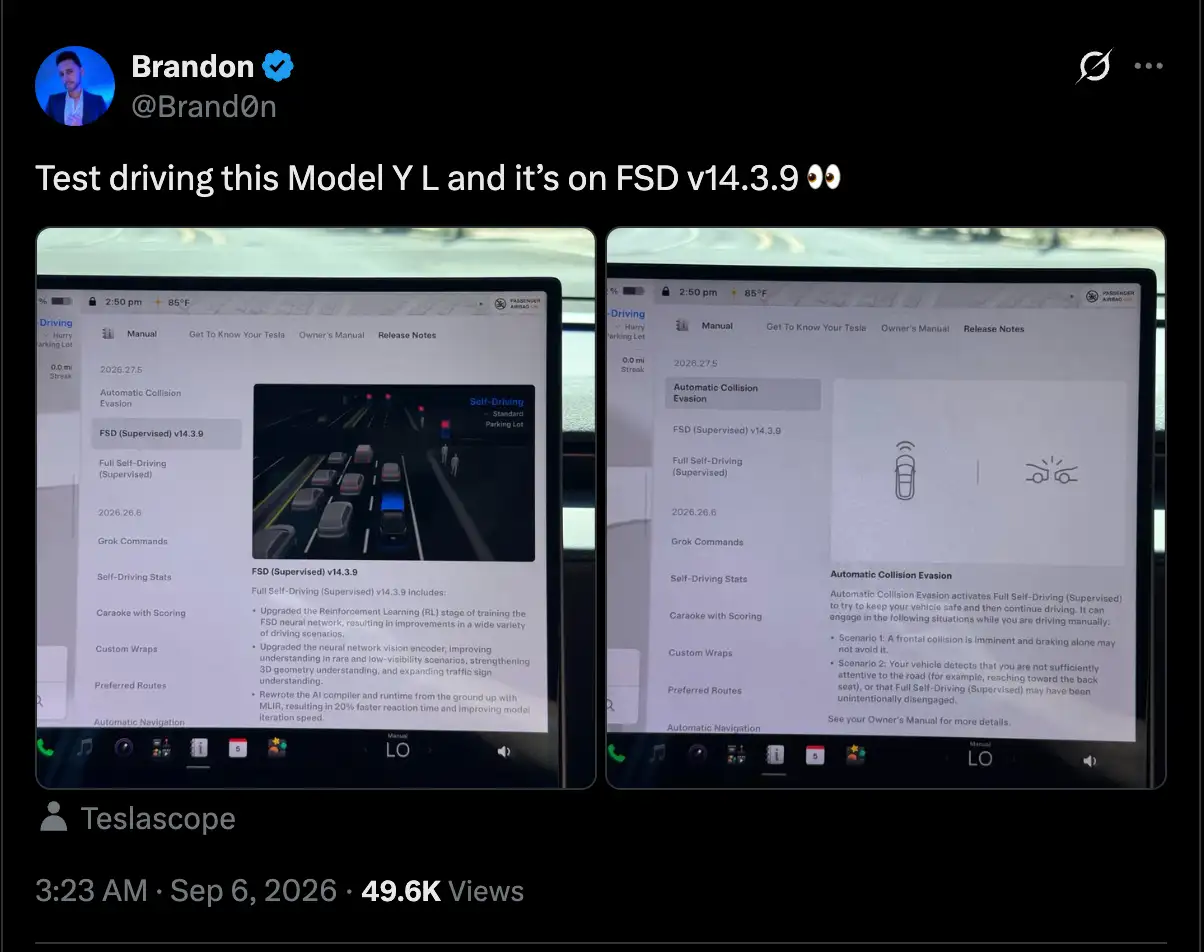
Tesla announced earlier this week that FSD (Supervised) v14.3.9 would begin rolling out soon. The company said the release would include a new active safety feature set that can activate FSD during some emergency events, including cases where Automatic Emergency Braking may not prevent a collision.
The presence of the build on a Model Y L test-drive vehicle confirms that Tesla has begun using the software outside the internal employee testing stage reported earlier. Yet Tesla has not said that version 2026.27.5 has entered a broad public rollout.
What Automatic Collision Evasion does
Tesla describes Automatic Collision Evasion as a feature that can activate FSD (Supervised) during manual driving. The system can take control in a limited set of emergency situations, attempt to avoid a collision, then continue driving after the danger has passed.
The release notes state: “Automatic Collision Evasion activates Full Self-Driving (Supervised) to try to keep your vehicle safe and then continue driving.”
The feature is intended to work when existing Automatic Emergency Braking may not be enough. AEB usually applies brakes when Tesla detects a risk of impact, yet braking alone may not prevent a crash when another vehicle enters the lane at close range or traffic suddenly stops ahead.
Automatic Collision Evasion can use the FSD stack to control steering, braking and acceleration. The system may steer into another lane or onto a shoulder when it identifies a safe path, rather than only braking in the vehicle’s current lane.
Two intervention scenarios
Tesla lists two scenarios for Automatic Collision Evasion. The first is an imminent frontal collision where braking alone may fail to avoid impact.
In that situation, FSD can activate during manual driving and perform an evasive maneuver. Frontal-collision intervention can operate on divided or controlled-access roads at speeds below 85 mph, or 137 km/h.
The second scenario involves driver attention. Tesla says the system can activate if it detects that a driver is not sufficiently attentive to the road, or if FSD (Supervised) appears to have been disengaged by accident.
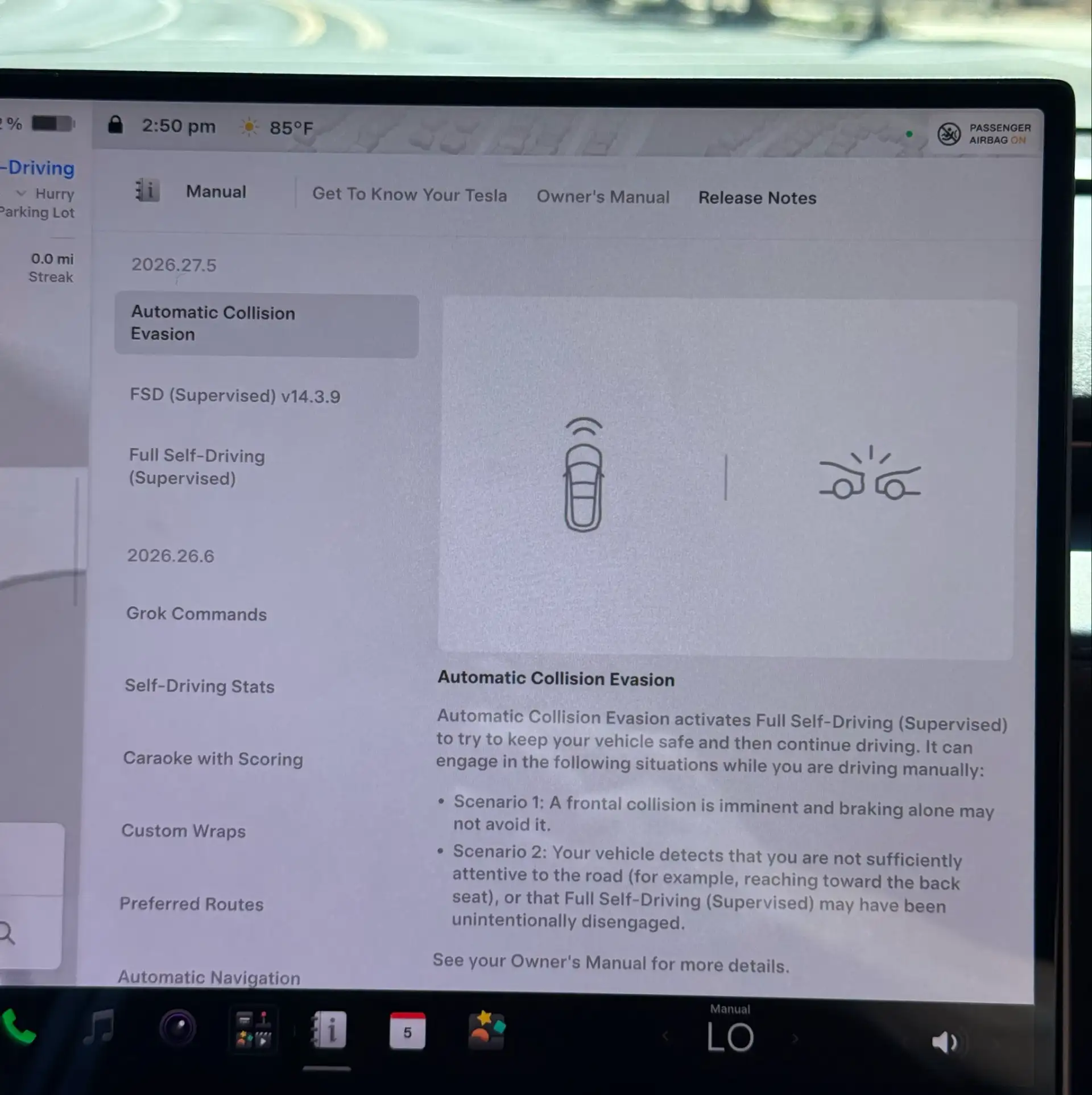
Tesla gives reaching toward the rear seats as one example of conduct that may trigger the function. Earlier reporting also cited severe driver distraction or loss of control as potential situations for intervention.
Reports place this second type of intervention between about 22.5 mph and 85 mph. Tesla has not released a complete public explanation of how it determines that a driver is distracted, how long the driver must be inattentive, or how it identifies an accidental FSD disengagement.
Driver remains responsible
The system remains part of FSD (Supervised), and Tesla continues to require drivers to monitor the road and be ready to intervene. Automatic Collision Evasion is an emergency function, not an autonomous-driving mode for consumer vehicles.
Also, accelerator input may not override the emergency maneuver. Brake input can add deceleration but may not end FSD control. A driver can regain control by applying firm force to the steering wheel.
Tesla has not yet published full owner’s-manual documentation covering every condition, restriction or control rule for Automatic Collision Evasion.
Rollout status
The Model Y L sighting provides an early look at Tesla’s 2026.27.5 software branch. It does not establish that the update is available to all FSD subscribers or all Model Y L drivers.
Tesla typically sends major FSD updates in batches, beginning with internal vehicles, test-drive cars and limited early-access groups before reaching more customers. In prior cases, Tesla test vehicles have run newer FSD builds before broader distribution began.
The next sign of a wider rollout will be confirmed reports from customer-owned vehicles and Tesla’s own software-update tracking. Until then, the most accurate description is that FSD (Supervised) v14.3.9 and Automatic Collision Evasion have appeared on at least one Model Y L test-drive vehicle.
We’ve launched an official Tesla Owners Online Forum. Join early and claim your "Founding Fuel" badge.