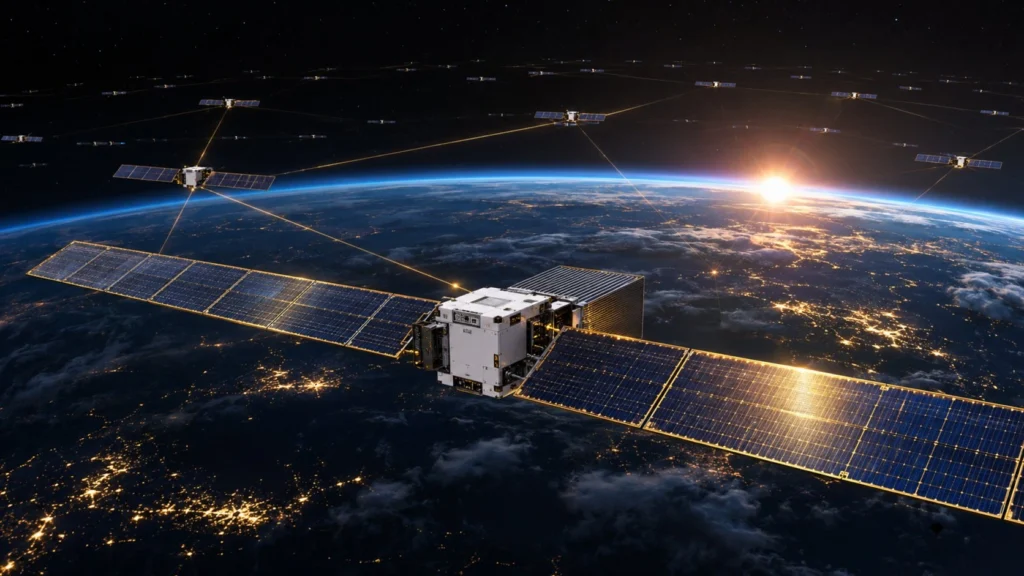
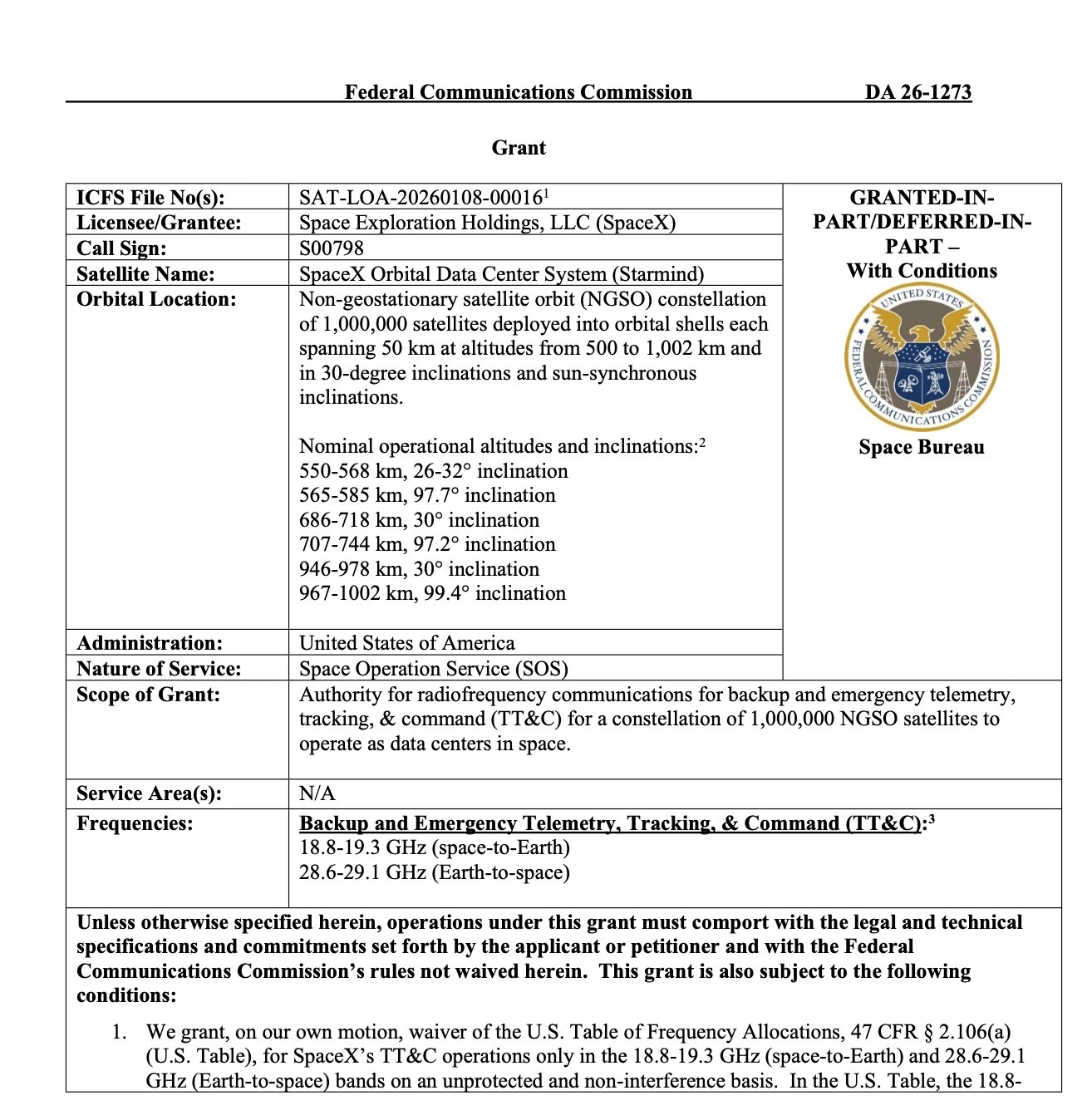
The Federal Communications Commission on Wednesday approved SpaceX’s plan to put up to 1 million Starmind satellites in low Earth orbit, in what the agency calls the first U.S. authorization for a constellation of data centers in space. The order, DA 26-1273, was issued by the FCC’s Space Bureau on Nov. 25, 2026, and took effect on release.
In its order the Bureau said the grant serves the public interest by letting SpaceX pioneer emerging technology that advances American leadership in space and artificial intelligence. The Commission said the project “promises to bring the human race closer to a Kardashev II civilization—one that can harness the full power of the sun.”
FCC Chairman Brendan Carr went further in a statement. “Compute campuses or data centers are essential to sustaining America’s leadership in SI. By moving compute capacity beyond Earth, SpaceX and the many competitors working on their own orbital data centers are meeting the moment,” he said.
What the license covers
The grant is marked “granted-in-part/deferred-in-part” with conditions, and it covers the SpaceX Orbital Data Center System under call sign S00798. SpaceX may fly 1,000,000 satellites in orbital shells 50 km thick at altitudes from 500 km to 1,002 km, a lower ceiling than the 2,000 km it asked for in January. The satellites will use 30-degree and sun-synchronous inclinations, with these nominal shells:
| Altitude (km) | Inclination |
|---|---|
| 550–568 | 26–32° |
| 565–585 | 97.7° |
| 686–718 | 30° |
| 707–744 | 97.2° |
| 946–978 | 30° |
| 967–1,002 | 99.4° |
The FCC licenses radio links and not the computers themselves, so the order deals mostly with spectrum. Main traffic will run over optical laser links to Starlink satellites, and Ka-band radio is cleared only for backup and emergency telemetry, tracking and command at 18.8–19.3 GHz down and 28.6–29.1 GHz up. SpaceX has to operate those links on an unprotected, non-interference basis and coordinate with federal and fixed-satellite operators, and it can only talk to gateway earth stations already licensed for its Starlink Gen1 and Gen2 systems. The Bureau waived the U.S. Table of Frequency Allocations on its own motion to allow that use.
The Bureau found it unlikely that an optical outage would ever push all 1 million onto Ka-band at once, and it rejected claims that the satellites would bounce radio waves into other services, saying those comments lacked technical support.
Deployment deadlines
SpaceX won waivers of the surety bond rule and the old milestone schedule, and the FCC applied the newer timeline it adopted in its space modernization order. The authorization becomes void if SpaceX misses these dates:
| Deadline | Satellites operating |
|---|---|
| Nov. 25, 2033 | 1 |
| Nov. 25, 2035 | 100,000 (10%) |
| Nov. 25, 2038 | 500,000 (50%) |
| Nov. 25, 2040 | 1,000,000 (all) |
The license runs for 15 years, and its clock starts at 3 a.m. EST on the day SpaceX certifies that the first Starmind satellite is in orbit and fully compliant. That filing is due within five business days of the satellite going into operation. SpaceX must file a final orbital debris mitigation plan before it deploys satellites above 600 km, and it has 30 days to decline the grant, with silence counting as acceptance.
Petitions denied
Kuiper Systems, which runs Amazon Leo, Viasat and the American Astronomical Society each filed petitions to deny the application, and the Bureau turned all three down. It dismissed concerns about environmental effects and harm to optical astronomy, saying the Commission has no authority over those topics, so the order calls for no further FCC environmental review.
But the objections have not gone away. DarkSky International, Environment America and Public Employees for Environmental Responsibility asked in July for a programmatic environmental impact statement, and astronomers filed close to 1,500 comments on the docket. Some analysts still expect orbital computing to cost more than ground-based data centers until around 2040.
How Starmind got here
SpaceX filed on Jan. 30, 2026, a few days before it announced its purchase of xAI, and the FCC opened the application for comment on Feb. 4. Elon Musk confirmed the Starmind name in June. Since then SpaceX has released specs for its first satellite, AI1, which has a 75-meter wingspan and an Nvidia Vera Rubin NVL72 computer rated at up to 250 kilowatts at peak, and each unit can weigh up to 4,000 kg. In November the company signed a solar cell equipment deal with German firm SINGULUS for its Gigasat factory in Bastrop, Texas.
No Starmind satellite has flown yet, and launches depend on Starship. Musk said this month that the first Starmind computers could reach orbit in the third quarter of 2027, but he called that date a guess. Rival orbital data center applications from Blue Origin, Starcloud and the startup Orbital are still waiting on FCC decisions.
Discuss this on Tesla Owners Forum →
We’ve launched an official Tesla Owners Online Forum. Join early and claim your "Founding Fuel" badge.